Friday, October 21, 2011

NYCC 2011: Shinobi

Our adventure into this year's New York Comic Con was not exactly as peachy as we would have liked, but when is a convention not stressful? We were only able to attend the Thursday and Friday events for both economical and physical reasons, but we got a handful of videos and impressions to make for you all.

---

At New York Comic Con, one of the third party games on display at Nintendo's booth was Sega's Shinobi for 3DS. This action-packed ninja adventure promises to bring back the old-school arcade experience that gamers have been wanting for the last few years. We got to play some of it there, and it feels like it is going to match the old school pretty well.

The demo started off with the protagonist talking with his sensei about basics and some advanced controls, and there was quite a lot to learn. I quickly decided to skip through the tutorial and jump head-first into the game, although in hindsight perhaps I should have gone through the tutorial a little bit. From the quick-passing screens, I could see a large amount of moves that the main character can do, from sword slashing to parrying to a new magic move which clears the screen in one blow.

As soon as I passed the tutorial, invading forces attacked the dojo and the game began in earnest. Like the older Shinobi games, this game is a side-scrolling action game in which you use the circle pad to move the ninja around and attack a vast onslaught of enemies using long-range shurikens and close-range combat. Unfortunately, the enemies can also throw throwing stars at you, and at the time, I did not realize that the parry move could knock off projectiles as they came to me. As a result, I got pummeled quite often in my time.


In the future, ninjas fight everything and everywhere!

Like real ninjas, the enemies do not give you much time to react, making the whole demo a high-octane experience, which was only made more complicated around the crowded and loud convention floor. If you can manage to sneak behind an enemy, you can take them out in a one-move takedown; if they spot you, you earn a sword to the face. While fighting, you can throw a chain upward to launch yourself toward higher places and especially toward airborne enemies for special combos. However, I could not find a way to launch the chain in any other direction; this was no Bionic Commando for me.


Of course, this screen shows we might be a little mistaken.

Besides fighting, the platforming felt pretty straight forward. The game allows you to use ninja skills to grab onto platforms, ropes, and anything else that a badass ninja needs to grab to get the job done. The game is clearly more combat-based, and perhaps that is a good thing when it comes to the Shinobi franchise.

Graphically, the style is more comic-based, if the boxart did not give this away. The fire effects and cel-shaded enemies further emphasize the comic style, but the backgrounds are pretty flat and lack detail where it should be expected. With stylized games like Okamiden showing up at the end of the DS's life with great aethetics, Shinobi came off to me as a simple, upgraded DS game in the texture department rather than a full-blown 3DS game. In 3D, the game looks nice, but there could have certainly been more usage of the display with the actions in the backgrounds. There should have been more to emphasize the 3D effects where possible.


Perhaps later worlds will better show off the 3D effect better.

While I was fairly inept at playing the game at the show floor, Shinobi looks like it will match the difficulty expectations of the series. I continued to get beaten up by the enemies and was confused by all the moves throughout; NYCC was probably not a good venue for me to try the game out, especially having skipped the tutorial entirely. Initial qualms aside, the game looks like it'll meet the expectations of Shinobi fans of yore.


Shinobi is expected for release this November.

Wednesday, October 19, 2011

NYCC 2011: Cartoon Network: Punch Time Explosion XL

Our adventure into this year's New York Comic Con was not exactly as peachy as we would have liked, but when is a convention not stressful? We were only able to attend the Thursday and Friday events for both economical and physical reasons, but we got a handful of videos and impressions to make for you all.

---

There is no denying that Cartoon Network has become one of the biggest child and adolescent programming channels on cable today, and it has a lot of characters new and old to thank for that. From the eco-friendly Captain Planet to the chef-in-training Chowder, the variety of characters is so large that it eventually spawns the question: who would win in a battle, Samurai Jack or Ben 10? Or Flapjack? Or the Powerpuff Girls?

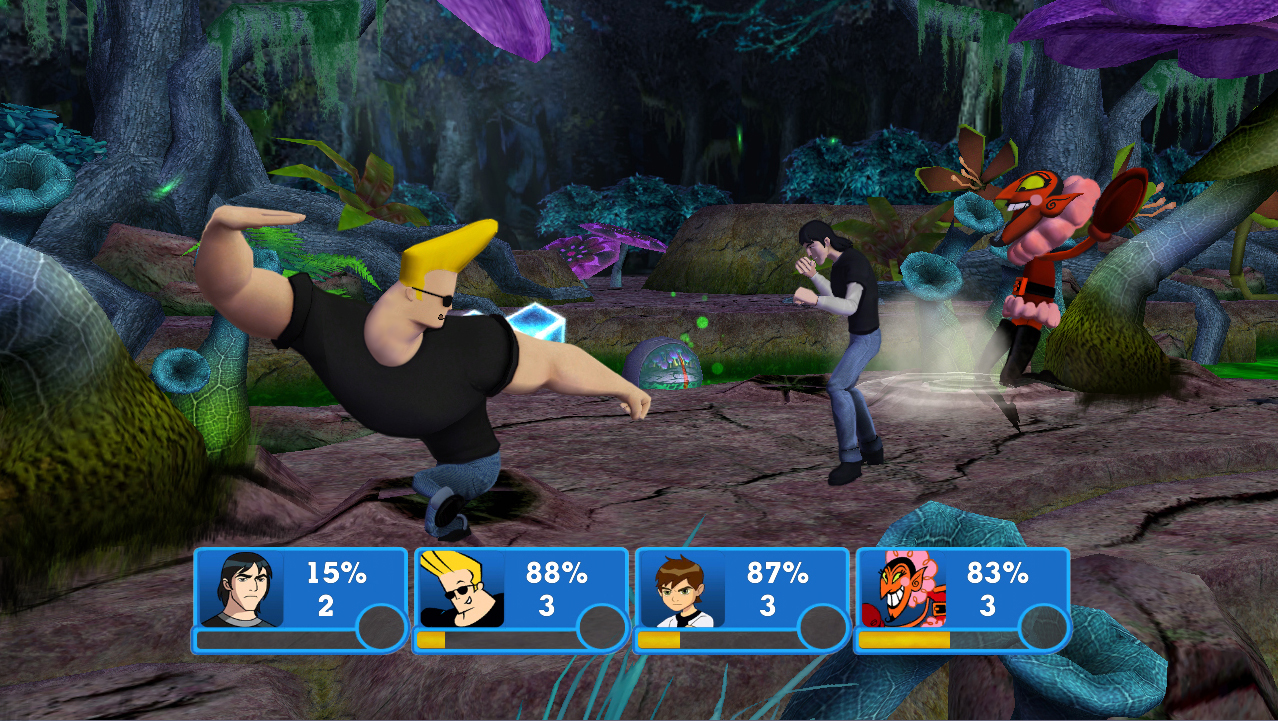
Enter Papaya Studio's Cartoon Network: Punch Time Explosion, a CN-themed fighting and action game. Originally released on the Nintendo 3DS this past summer, Punch Time Explosion is getting a special XL edition for home consoles this holiday season, and from what we saw at Comic Con, it is certainly improving on what the original game had established. For one, the new adventure consists of as many as eight brand-new characters, including Him from Powerpuff Girls and Kevin Eleven from the Ben 10 series. Also, a large number of new battle maps have been added, expanding the locales of the many worlds, including Mandark's Lab and Candied Island. So for those who liked the 3DS version and wanted more of everything, there is nothing to worry about here.


Toiletnator is about to get beat down.

Of course, an XL version is not just more characters and levels. The console version's graphics have been improved, and the framerate has been stabilized, which is certainly helpful for keeping up with the action. Players can play the Story Mode cooperatively, and there are a number of new battle modes for multiplayer. There is even a Practice Mode so you can learn each new character's abilities before you jump into the fray. Even older characters have new abilities, particularly the Synergy Attacks, in which an assisting character and the playable character join together to perform a special destructive attack on unsuspecting opponents.


In this lab, it is all fun and no work.

From my experiences, the game has quite a bit of activity happening, and at first, the controls might be a little daunting, but even less experienced players should do rather well, what with the Punch Time Explosions and assist attacks. Considering all the characters, crazy level selection, and new Synergy Attacks, this game will certainly compare well against Super Smash Brothers Brawl, and considering there are not many games like this on HD platforms, this could be a good contender for children's wish lists this holiday.


Check the pecks, then check this punch!

We had an interview with Senior Producer Richard Robledo regarding the game and its new features, not to mention the controversial question: which Cartoon Network character is his favorite?


Cartoon Network: Punch Time Explosion is available now for 3DS and the console XL version will be available this holiday season under a budget price. For more information, head to the official website.

Saturday, October 15, 2011

NYCC 2011: Skylanders: Spyro's Big Adventure

Our adventure into this year's New York Comic Con was not exactly as peachy as we would have liked, but when is a convention not stressful? We were only able to attend the Thursday and Friday events for both economical and physical reasons, but we got a handful of videos and impressions to make for you all.

---

When it was announced earlier this year, Skylanders: Spyro's Big Adventure was met with a mixed reaction, mostly toward the cash-grab mentality the concept reflected. Essentially, Skylanders is a toy and game combination aimed toward children, all while rebooting the Spyro franchise and introducing a myriad of new characters for marketability. Using a portal device, players input characters to the game via individual toy statues; the games each come with three figurines, and there are over thirty in total. Consequently, not only do you have to purchase the games, but you also have to purchase additional toys to play as every character.

While this negativity toward Activision is understandable, that negativity does not necessarily outdo the fact that the game is pretty darn fun.

At New York Comic Con, I got my hands on the 3DS version of the game, and a developer from Vicarious Visions was there to answer my questions and help relay information on the titles. While we chatted about the game and its features (as we talk about in the below video), I played through the first few areas the game had to offer, and overall I was pretty impressed.


A scene from the console version, when it was first announced.

Unlike the console versions in which the portal needs to be activated at all times for character swapping, the handheld edition allows players to store two heroes in the game at one time, but to change characters outside of the stored ones, the portal will need to be used. Also unlike the console version, the 3DS version of the game is more platform-intensive, and from what I played, that is certainly true. In the last Spyro series, the games were more focused on beat-em-up scenarios; this rendition puts more emphasis on quick battles and unique character abilities. According to the developer, the handheld version is more fast-paced than the console version, and while I cannot confirm that, the game did feel well-paced.


The Portal, not just a display for your Skylanders figurines.

Swapping characters was quick and easy, and as I played, they did have their little differences. Dark Spyro, for instance, glided across gaps while Ignitor, the other character in the demo, provided a double jump for platforming. As the game progresses, each character gains experience and, subsequently, abilities as they venture through each level of the game. While there are no extreme RPG elements in here, the leveling concept does make replaying the game more acceptable; having so many characters to choose from helps that as well.

Perhaps my biggest fault with the game from my hands-on time was the framerate. Seeing as this demo was probably a very complete version of the game, the framerate was disappointing. Sitting at roughly 20 fps, the game felt occasionally stilted. Thankfully, the 3D effect is greatly utilized, with large towers and drops which make good use of the 3DS display. The graphics are bright and do not show much of the faults a number of third party games on the 3DS did before. It certainly does not feel like an up-port, thank goodness!


The handheld game accepts all characters from the console versions, too.

We were told that there will be at least 30 characters, of which two are exclusively included in Starter Packs: Spyro with the console game and Dark Spyro with the handheld edition. This does make the game initially expensive. Thankfully, the game seems very solid and certainly welcoming to younger gamers. Will it be brought to the same height as the original Spyro series? Well, perhaps that depends on your perception of the original series. At the very least, this is a unique take on the franchise, and it is certainly not a bad one.

Skylanders is out now, but if you want some quick impressions over Comic Con footage, look no further!


Sunday, October 2, 2011

eShop Rating-Sales: September 2011

The Nintendo eShop is Nintendo's online shop through the 3DS where people can download games from old Nintendo hardware, DSiWare games, and new download software specific for the 3DS. Because Nintendo does not disclose sales numbers, and developers are most likely barred from revealing them, we do not know how games are doing on the service.

But we might have at least a small hint.

After playing a game on the 3DS for over a hour, players are capable of rating these games via the eShop, and the totals are shown on each game page, showing up to five stars based on what the population thinks. At the very least, we now have minimum sales figures for the games, but with a very large disclaimer: these numbers represent the users who have done the following:

1) Purchased the game
2) Played the game for over an hour on the 3DS, and
3) Chose to rate the game on the eShop.

People who play the games on their DSi systems cannot rate games, nor can people who have not played the games for less than one hour. Since rating cannot be done outside of the eShop, some might have forgotten to or chosen not to rate said games. Also note that a rating does not necessarily correspond with a sale in the month in which it appears, only emphasizing the number of additional people who completed the above steps.

With that disclaimer in mind, let us take a look at how the games performed.

---

Free Apps
1/1 Nintendo Video 7158 19206
2/2 Pokedex 3D 5371 31464
3/3 Netflix 3331 14147

Unmoved from last month, Nintendo Video remains the most-rated product in Nintendo's applications, but Pokedex 3D is still the most-rated download software on the eShop to date. At the very least, roughly 30 to 40 thousand people have accessed the eShop at some point, but I imagine the number to be greater overall.


Pre-eShop DSiWare*
1/1 Plants vs. Zombies 647 3623
2/2 Photo Dojo 496 2643
3/3 Cave Story 424 2791
4/5 Inchworm Animation 419 1707
5/4 Mario vs. Donkey Kong: Minis March Again! 404 2387
6/7 Anonymous Notes Chapter 1 - From the Abyss 304 1342
7/10 Zenonia 299 1128
8/6 Shantae: Risky's Revenge 281 1911
9/8 Bomberman Blitz 211 1091
10/12 Mario Clock 209 972
11/9 GO Series: 10 Second Run 203 839
12/11 Tetris Party Live 194 999
13/13 Pop Island - Paperfield 168 788
14/15 Army Defender 162 614
15/14 Soul of Darkness 122 595
16/16 Dark Void Zero 119 622
17/00 JellyCar 2 108 585
18/17 Dr. Mario Express 96 580
19/19 Anonymous Notes Chapter 2 - From the Abyss 71 386
20/18 Extreme Hangman 59 424
21/00 Arcade Bowling 56 267
22/20 GO Series: Defense Wars 33 136
23/21 WarioWare: Snapped! 31 180

*The list might not include games with higher rating counts, as it omits a large portion of prior DSiWare releases.

More or less the top 6 games remained as such, although there are some movements lower down the list. There does not appear to be any surprise in the current listing of old DSiWare games, at least not yet. Meanwhile, Nintendo this past month posted a "Biggest Movers" category in the eShop, and including newly charted games, represent the added chunk of games to the list for next month.

Crystal Monsters 638
Nintendo Countdown Calender 353
Pop Island 332
Touch Solitaire 317
My Farm 279
Paper Airplane Chase 227
Blazybloo: Super Melee Action Battle Royale 217
Mario Calculator 193
5 in 1 Solitaire 180
My Exotic Farm 175
Castle Conqueror 168
Gangster 2: Kings of L.A. 160
Earthworm Jim 149
AiRace 144
A Topsy Turvy Life: The Turvys Strike Back 63
Petz Dogz Family 51
Petz Kittens 38

Yes, Nintendo listed two Petz games in the "Biggest Movers" section. I have my doubts, but we will see next time if the category meant much.


Post-eShop DSiWare
1/00 The Legend of Zelda: Four Swords Anniversary Edition** 1679 1679
2/16 Let's Create! Pottery 99 112
3/01 Afterzoom 80 376
4/00 GO Series: Fishing Resort 61 61
5/02 Extreme Hangman 2 56 213
6/05 Go! Go! Kokopolo 51 96
7/18 Magical Whip 47 58
8/03 The Lost Town: The Dust 46 168
9/20 Build-a-lot 29 38
10/32 Calculator 29 32
11/06 My Australian Farm 27 71
12/13 My Asian Farm 25 42
13/07 Moto eXtreme 22 96
14/04 Antipole 22 113
15/31 Zoonies - Escape from Makatu 19 23
16/09 Make-Up & Style 17 82
17/00 House M.D. - Blue Meanie 17 17
18/12 Pro Jumper! Guilty Gear Tangent!? 16 70
19/00 Defense of the Middle Kingdom 16 16
20/19 Kung Fu Dragon 14 25
21/26 Crazy Hamster 14 20
22/10 GO Series: Portable Shrine Wars 13 45
23/23 Blockado - Puzzle Island 13 20
24/00 Break Tactics 13 13
25/08 Stratego: Next Edition 12 87
26/14 Farm Frenzy 10 35
27/15 Heart Spaces Euchre 8 32
28/17 Puzzle Fever 8 29
29/25 Roller Angels 7 26
30/11 Jewel Keepers: Easter Island 7 44
31/22 Trollboarder 7 17
32/27 Zimo: Mahjong Fanatic 6 19
33/24 Delbo 6 28
34/00 DotMan 6 6
35/28 Hidden Photo 5 20
36/00 Puzzle Rocks 5 5
37/00 Escape Trick: Ninja Castle 5 5
38/34 Boardwalk Ball Toss 4 15
39/36 Go Fetch! 2 4 6
40/33 Gold Fever 3 18
41/21 Beach Party Craze 2 20
42/29 Oscar's World Tour 2 7
43/30 Play & Learn Spanish 2 7
44/00 Bridge 2 2
45/35 Just SING! 80s Collection 1 3
46/37 B-Team - Episode 2: Ice & Venom 1 2
47/00 Bugs 'N' Balls 0 0
48/00 Crystal Caves of Amen-Ra 0 0

**This game is free and will be available for free until February 20th, 2012.

Even a couple of days after its debut, Four Swords Anniversary Edition happens to become the most-rated game from new DSiWare titles, although that is to be expected. The game is and will remain free for months, so I suspect it will stay at Number 1 until then. Outside of that large outlier, the highest new release goes to GO Series: Fishing Resort with 61 ratings. Last month's biggest rated title, Go! Go! Kokopolo, only debuted with 45, although it has since more than doubled in ratings, a good sign for a good game. However, the biggest mover from last month's releases was not Kokopolo but Let's Create! Pottery, with 99 ratings this past month.

The last two games, both without a single rating, were only out for a full day when I gathered data, so if they are good, expect them to shoot up the charts come next month.

After Zelda, the most-rated post-eShop DSiWare title remains to be Afterzoom.


Virtual Console

1/1 Legend of Zelda: Link's Awakening DX 1693 14452
2/2 Super Mario Land 1006 8464
3/4 Kirby's Dream Land 595 2572
4/3 Donkey Kong 463 3319
5/00 Mega Man: Dr. Wily's Revenge 275 275
6/5 Mario's Picross 238 806
7/7 Gargoyle's Quest 225 350
8/6 Game & Watch Gallery 185 802
9/00 Super Mario Land 2: 6 Golden Coins 81 81
10/8 Alleyway 64 585
11/9 Avenging Spirit 48 119
12/00 Pac-Man 47 47
13/10 Qix 30 170
14/11 Baseball 27 126
15/12 Radar Mission 23 203
16/14 Tennis 17 138
17/13 Fortified Zone 15 91
18/00 Golf 14 14

The top 4 games remained as expected, although Kirby outdid Donkey Kong this month. The most-rated new release was Mega Man: Dr. Wily's Revenge with 275 ratings. The other Capcom release, Gargoyle's Quest, sits at the top of third-party VC releases. The worst-performing game of the bunch was Golf, which also debuted this week. Word of advice for Nintendo: do not release a GB Golf title within weeks of releasing an NES Golf game for the Ambassador Program. Also, Super Mario Land 2 was barely out when the month ended; expect it to do well next month.

Link's Awakening DX remains the highest-rated title on the eShop that was never available for free at any time. Outside of new releases, Fortified Zone remains the least-rated VC title, with only 91 ratings.


3DS Download Software
1/1 3D Classics: Excitebike* 1399 17490
2/2 Let's Golf! 3D 456 1351
3/3 3D Classics: Xevious 241 901
4/4 3D Classics: Urban Champion 210 401
5/0 3D Classics: Twinbee 67 67

*This game was available for free during the month of June 2011.

Like last month, the actual 3DS games from eShop went up in count by one, and it happened to be another 3D Classics title. Twinbee only had a week to perform, and it did poorly, with only 67 ratings. Urban Champion, despite being seen negatively upon release, still sits at a total of 401 ratings. Let's Golf! 3D surpassed 1000 ratings, and Xevious appears to be on the verge, as well.

As expected, 3D Classics: Excitebike remains the most-rated 3DS download software and, outside of Nintendo Video and Pokedex 3D, is the most-rated product on the eShop. I do not expect this fact to change into the near future.

Overall
1/2 Legend of Zelda: Link's Awakening DX 1693 14452
2/00 The Legend of Zelda: Four Swords Anniversary Edition** 1679 1679
3/1 3D Classics: Excitebike* 1399 17490
4/3 Super Mario Land 1006 8464
5/6 Plants vs. Zombies 647 3623
6/5 Kirby's Dream Land 595 2572
7/8 Photo Dojo 496 2643
8/4 Donkey Kong 463 3319
9/7 Let's Golf! 3D 456 1351
10/9 Cave Story 424 2791
11/12 Inchworm Animation 419 1707
12/10 Mario vs. Donkey Kong: Minis March Again! 404 2387
13/15 Anonymous Notes Chapter 1 - From the Abyss 304 1342
14/19 Zenonia 299 1128
15/13 Shantae: Risky's Revenge 281 1911
16/00 Mega Man: Dr. Wily's Revenge 275 275
17/14 3D Classics: Xevious 241 901
18/11 Mario's Picross 238 806
19/29 Gargoyle's Quest 225 350
20/17 Bomberman Blitz 211 1091

*This game was free for the month of June 2011
**This game is and will be free until February 2012


In a way, it is sad to see only two new games appear on the Top 20, but between free games, great handheld virtual console titles, and the 10-game Ambassador Program, I suspect the ratings to have dropped as a result. Link's Awakening DX remains at the top, but Four Swords Anniversary Edition almost surpassed it, followed by the other-once-free title on the eShop 3D Classics: Excitebike. The only paid-for debut in this now Top 20 is Mega Man: Dr. Wily's Revenge. Meanwhile, the only August games on this list are Mario's Picross and Gargoyle's Quest.

What's in store for October? Well, there will almost certainly be a 3D Classics title, and Japan is getting a unique game developed by Intelligent Systems. As for other titles, Wayforward's newest title might appear in the next couple months, so keep a look out!

Friday, September 23, 2011

Third Rate Game Play: The Legend of Zelda: Ocarina of Time 2D / 3D [Part 1]


Game: The Legend of Zelda: Ocarina of Time 2D/3D
System: Nintendo 64 / Nintendo 3DS
Developer: Nintendo EAD / GREZZO
Publisher: Nintendo
Player: Tony / Alex
Experience: Tony has beaten it multiple times. Alex has not.


The Legend of Zelda is seen as one of the absolute best franchises in gaming, and it just so happens that this year, 2011, is the game’s 25th anniversary. Unlike the less-than-stellar anniversary Nintendo threw Mario, Zelda has been receiving a collection of goodies throughout the year, and one of them is a remake of one of the best Zelda games in the series: The Legend of Zelda: Ocarina of Time.

The Legend of Zelda was originally inspired by director Shigeru Miyamoto’s childhood, in which he would wander alone around hidden lakes and caverns. It is from this that he would develop the main exploration elements to the original game, which debuted in Japan on February 21, 1986. The United States would receive its cartridge version in mid-1987. Since then, Zelda has become a major Nintendo franchise, behind only Mario and Pokemon in pedigree. Zelda II: The Adventure of Link (1987) was developed with Miyamoto as the Producer; in this venture, the game was more akin to a classical action RPG, which featured leveling and random battles via side-scrolling arenas and dungeons. Later, when the Super Nintendo released, Nintendo EAD was already far into development with a new Zelda adventure. The Legend of Zelda: A Link to the Past debuted in 1993 and was a return form and then some. The new game introduced a myriad of new items, upgradable tunics, bright graphics, and the aspect of dual worlds, a light world and the menacing dark world. While other Super Nintendo games were developed with the Zelda franchise, they were only made in conjunction with the Japanese-only add-on, the Satellaview. Those games included BS Zelda no Densetsu: Map 1 and Map 2 (which is more akin to a timed remake of the original), BS Zelda no Densetsu: Kodai no Sekiban (Ancient Stone Tablets, which acts as a new adventure in the Link to the Past world), and BS Zelda no Densetsu: Kamigami no Triforce (Triforce of the Gods, which is just A Link to the Past). Finally, before Nintendo debuted a new Zelda for the Nintendo 64, its third major console, Nintendo’s Zelda team worked on a GameBoy adventure, The Legend of Zelda: Link’s Awakening. In this 1993 release, the game introduced a number of new items and focused on a world different from Hyrule, full of monsters well outside the franchise’s norm.

The Legend of Zelda: Ocarina of Time was originally debuted to the public at Nintendo’s Space World trade event in late 1995, developed using a heavily-modified Super Mario 64 engine. When the game began its development, it was being made with the usage of the special Nintendo 64DD (or Disk Drive) add-on peripheral. This special add-on would allow a larger number of saved objects and situations to be developed over the course of the game. However, Ocarina of Time eventually was put onto a cartridge with the expectation to make expansions with the 64DD in the future. The expansions would never release for the 64DD as the peripheral failed, but the projects would appear in other ways in the future.

When it released, Ocarina of Time would emerge with three versions known to this day: The Collector’s Edition, which was in a limited gold cartridge, the “Red Blood” version, which contains the same contents as the Collector’s Edition without the gold cartridge, and the final version of Ocarina of Time for all future shipments and re-releases.

But this is not only an episode dedicated to the original The Legend of Zelda: Ocarina of Time. No, this is also an episode dedicated to the 2011 3DS remake, The Legend of Zelda: Ocarina of Time 3D. This iteration was developed with some Nintendo EAD help, but it was independent studio GREZZO which did most of the work. GREZZO was established in December 2006; its name comes from the Italian term “Diamante Grezzo,” which means “Diamond in the rough.” According to its company message, it refers to the required work behind polishing ideas into diamonds and building great content from novice game designers. Its CEO is Koichi Ishii, whose previous works at Square-Enix included planning and game design for Final Fantasy and Final Fantasy II, directorial roles in Secret of Mana, Seiken Densetsu 3 (Secret of Mana 2), Legend of Mana, Sword of Mana, and Dawn of Mana. He also produced the rest of the Mana series, which includes Children of Mana and Heroes of Mana. GREZZO’s first known release was Line Attack Heroes for WiiWare, a game in which players use lines of warriors to attack their enemies; the game was announced in late 2008 as a retail game but would be released as a WiiWare game in Japan only, late July 2010. Ocarina of Time 3D comes as the company’s first retail release.


“The Legend of Zelda™: Ocarina of Time™ 3D takes the Nintendo 64™ classic – one of the most critically acclaimed games ever made – and returns it to the Nintendo 3DS system with the added depth and realism of stunning, glasses free 3D visuals. In this game, Link™ sets off on a legendary journey through time to stop Ganondorf, the Gerudo King of Thieves who is seeking the Triforce, a holy relic that gives its holder ultimate power. The graphical upgrades and three-dimensional depth breathe new life into the expansive world of Hyrule. An improved and intuitive interface, coupled with the easier navigation offered by playing in a world with 3D visuals, give players better control as they solve puzzles, travel through time and explore this immersive world. Whether you're a first-time player or a regular visitor to Hyrule, The Legend of Zelda: Ocarina of Time 3D is a new adventure for everyone.”
"Simply put, I'm really glad we remade it for the Nintendo 3DS system. Earlier, I said that we were able to give Hyrule a kind of warmth or scent in the Nintendo 64 version. Now that it is in stereoscopic 3D, I think we were able to convey the atmosphere even better—thanks to all the hard work that Grezzo put in! We also redid a lot of the textures….And it isn't a port. It is a remake, but in the truest sense of the word."
-General Producer, Shigeru Miyamoto
“I often compare making video games to cooking. If game developers are like cooks, then the games they make are like food. Just as the techniques of the cooks influence the way their food tastes, the techniques and experience of game developers appear in the games...So I thought it would be a failure as a product if people who made the original game weren't involved, causing it to turn out as something that was merely somewhat like the original game, something that looked the same but tasted different. I felt like an important theme this time was how we could make The Legend of Zelda: Ocarina of Time 3D today.”
-Koichi Ishii, Producer, GREZZO


The Legend of Zelda: Ocarina of Time follows the adventure of Link, a young boy raised in Kokiri Village who suffers from nightmares involving a young girl and a tall, red-haired menace. It is discovered by the Village’s sage, the Great Deku Tree, that Link is destined to save Hyrule from destruction and must obtain the three Spiritual Stones necessary to enter the Temple of Time and obtain the Master Sword, the sword which can vanquish evil. With the help of Navi, a fairy entrusted by the Deku Tree to follow Link, the young boy must now face off against monsters the world over and find himself pulled through time into a dark future in order to save it.

The game is the first 3D offering of the Zelda franchise, although it still follows a similar game design to that of A Link to the Past. The biggest addition to the series in addition to the 3D perspective is the special Z-targeting system, through which Link can lock onto monsters and other important items for easier fighting and actions. The game also has a day-night cycle which can change the activities in towns and other locations throughout Hyrule. The game has a vast number of other additions which build upon the Zelda formula, although one of the most memorable of them happens to be the introduction to Epona, a horse on which Link can ride around the world in order to travel faster across Hyrule Field and other locales.

The Legend of Zelda: Ocarina of Time 3D is a mixture between a remake and a port of the original game. Most of the game’s textures have been remade, and Link’s model has been entirely redesigned. However, some other models have not been given as large an update as the hero’s, and the music has been left almost untouched in order to retain a nostalgic flair. Outside of the 3D display, OoT3D allows players to use the 3DS gyros to aim and look around in first-person. Once the main game is completed, players can take part in the Master Quest, which mirrors the main world and redesigns harder dungeons, and after a while, players are capable of re-fighting bosses within the game for the fastest time. Those having difficulty in-game can look into Sheikah Stones, which provide visual hints on what to do at particular parts in and out of dungeons.


The Legend of Zelda: Ocarina of Time is seen by many as the pinnacle of the Zelda series, and today it sits among the highest-selling games for Nintendo during that generation. It helped shape Zelda into what it is today, and many of the games which released following it were in some way related to the game’s storyline.

As said in the background, Ocarina of Time was developed with 64DD add-ons in mind: the codenames were specifically Ura Zelda and Zelda Gaiden. Ura Zelda was to be an expansion or “Second Quest” for the original, but when the 64DD failed to meet expectations, it was scrapped. This version, entitled The Legend of Zelda: Ocarina of Time Master Quest, was eventually released exclusively on a special pre-order disk for The Legend of Zelda: Wind Waker and is what the Master Quest in OoT3D mimics. Zelda Gaiden was much more different, and it would later be released as The Legend of Zelda: Majora’s Mask, which takes place immediately after the events of Ocarina of Time and in a new, near-apocalyptic world.

The next Zelda game, the aforementioned Wind Waker, also took place following the end of Ocarina of Time, albeit from the other timeline (a complicated endeavor to explain, so just agree with me here). Wind Waker changed from the more traditional style established in OoT and shifted toward a cell-shaded artstyle, which initially drew criticism from the Zelda fandom. Following a seafaring Link with the ability to control winds, this adventure was a great departure from the horse-riding Link we had come to know and love from the Nintendo 64. Over time, however, the game and its style grew on the fans, and its style has been used in a number of games since (Four Swords, Minish Cap, Phantom Hourglass, and Spirit Tracks). In perhaps a bit of overcompensation, the next major game, The Legend of Zelda: Twilight Princess, took Zelda to a more realistic, Lord of the Rings-based design. While it was anticipated for a 2005 release, the GameCube title was delayed a year to release alongside a mirrored Wii version, complete with motion and pointer-based control additions. In no surprise, it, too, existed in the timeline of Ocarina of Time, albeit much further out than Majora’s Mask.

Near the end of this generation, the Wii is about to get its first from-the-ground-up Zelda title: The Legend of Zelda: Skyward Sword. The game is said to be the prequel to Ocarina of Time and will explain the origin of the Master Sword. Skyward Sword, expected for a November 2011 release, will make use of the Wii Motion+ peripheral and will feature many new ideals for the Zelda franchise, including item creation and multiple passes through dungeons. Needless to say, this 25th Anniversary game will certainly be a great way to round out what Ocarina of Time 3D started.

GREZZO is not finished with Zelda, at least not yet anyways. The company is also the development team behind the DSiWare release The Legend of Zelda: Four Swords Anniversary Edition. This game is mostly a port of the GameBoy Advance title Four Swords, which Capcom developed alongside the GBA version of The Legend of Zelda: A Link to the Past. On top of 3DS-to-DSi connectivity, Anniversary Edition will include a single-player option and two extra worlds, one of which contains skins from the NES, GB, and SNES Zelda titles. Seeing their previous products, GREZZO will most likely continue its work with Nintendo. Who knows? We might see another 3D Zelda remake!


People said they were crazy, but they did it. Alex and Tony decide that showing off Ocarina of Time 3D alone was not enough! They decide to start an adventure together, Alex playing the 3DS version and Tony playing the N64 original. Dubbed “2D” and “3D,” the two Links work together to save the world. In this part, the duo works through the first hour of the game. That is: the Deku Tree and meeting Princess Zelda herself! They try to get cutscenes done at the same time to help compare the games graphically, but when the two race through the dungeon, they do not wait for each other.

How did they fare? Find out!


This first part of the en tandem series worked out rather well, considering the situations that arose. In particular, we did not want a glare from the two televisions to mess up the 3DS’s view, but we fixed that with a cardboard blinder that spanned a good two and a half feet long. Unfortunately, as noted by Mark partway into the recording, the 3DS’s view was fuzzier than previous 3RGP 3DS adventures, most likely due to some focus issues that were missed out on as the episode was recorded. In the end, the quality of the 3DS version is less than that of the N64 version, although you can clearly see the 3DS’s improvements in other ways beyond the crisp visuals.

The actual commentary was focused more on the sheer difference between games than trying to be too humorous. We intend to fix that as the game progresses. On that note, we have already filmed the second part and intend to have the rest of the game shown in the future, hopefully sooner rather than later.

Will Star Fox 64 3D follow a similar simultaneous playthough? We will get back to you on that, but things are looking good for the future!


3RM Says: Ignore the giant shrub to your right and listen to me, the Great
Deku Tree! Yes, I was always this red. I'm a redwood, of course!